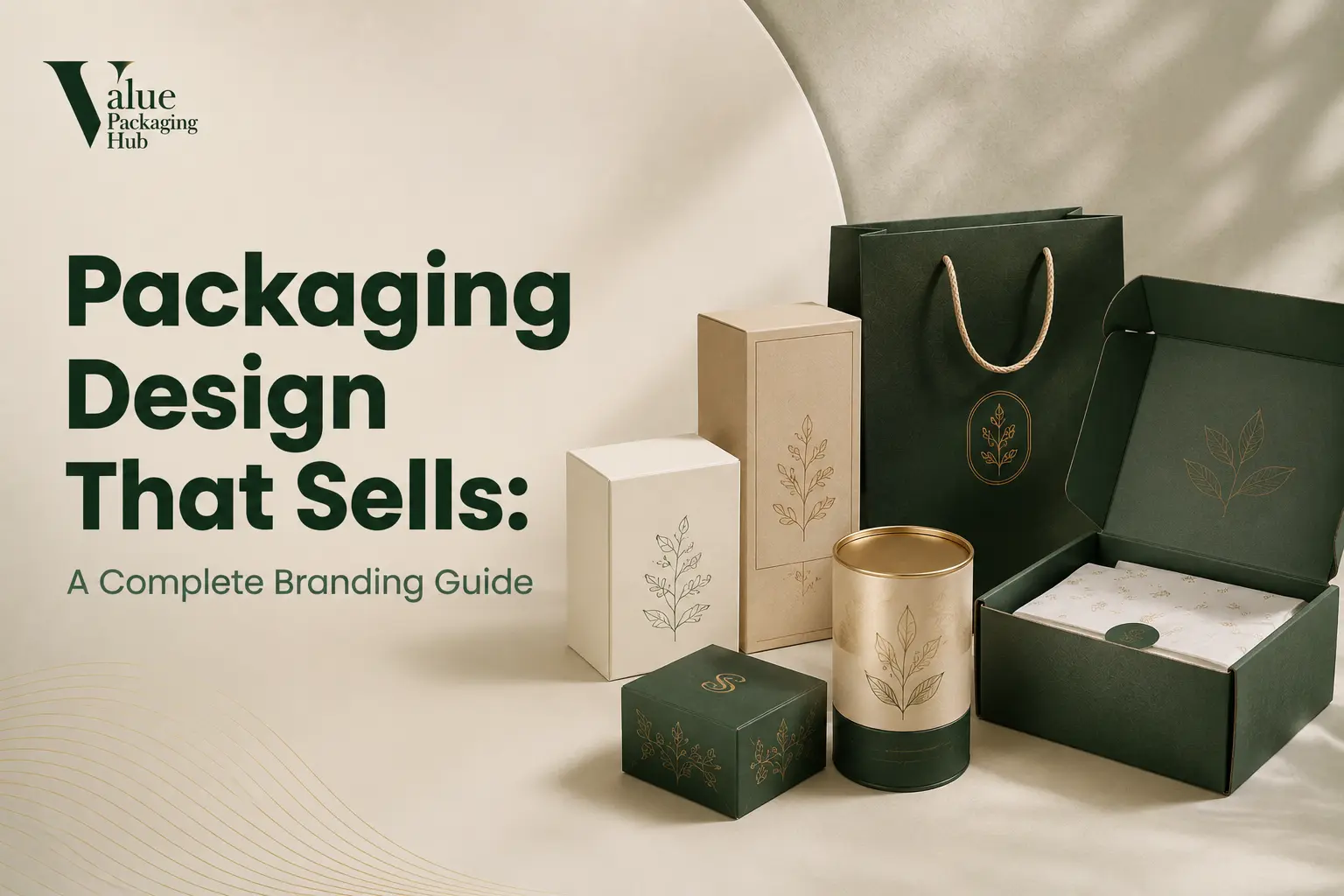
Packaging Design That Sells: A Complete Branding Guide
Your packaging has seven seconds to make a sale. That’s how long consumers take to form a first impression before moving to the next product on the shelf or scrolling past it online. 81% of consumers have purchased a new product because of its packaging design, and 72% agree that packaging design can directly influence their purchasing decision. For US businesses competing across retail shelves, ecommerce listings, and social media unboxing content, packaging design is not decoration — it is one of the most measurable revenue drivers available. Here is everything you need to know to design packaging that builds your brand and converts browsers into buyers.
Key Takeaways
- Over 78% of first-time product purchases in 2024 were influenced by packaging appearance, and packaging design impacts up to 72% of impulse purchases.
- Great packaging design balances six core elements: structure, typography, color, imagery, materials, and information hierarchy — every element must work together.
- The packaging design process follows seven steps from brief to production — skipping any step increases the risk of costly redesigns or compliance failures.
- Sustainable packaging design adoption reached 54% among global brands in 2024, with minimalist visual formats growing 29% — both now mainstream expectations, not optional extras.
- A dieline is the flat structural template that defines how your packaging folds and assembles — every packaging design starts with one.
- Value Packaging Hub offers custom packaging design services with free design consultation, free 3D samples, low MOQ, and free delivery across the USA.
What Is Packaging Design?
Packaging design is the process of creating the visual and structural identity of a product’s container — combining graphic design, materials science, and brand strategy into a physical object that must simultaneously protect the product, communicate the brand, and persuade the buyer. It encompasses everything the customer sees and touches: the box structure, the typography, the color palette, the imagery, the finish, and the information layout.
Packaging design operates at two levels. Structural design determines the physical form — the dieline, the box style, the material, and the engineering that makes it manufacturable and functional. Graphic design determines the visual communication — the brand colors, logo placement, typography hierarchy, and imagery that create an emotional response and drive purchase decisions.
Both levels must be designed in concert. The most visually striking packaging in the world fails if it falls apart in shipping. The strongest box structure fails if the design doesn’t stop someone from scrolling past it.
The 6 Key Elements of Packaging Design
Packaging Design Elements Comparison
Element | What It Does | Common Mistake |
Structure & Dieline | Defines how box folds and functions | Designing graphics before the dieline |
Typography | Communicates brand voice and hierarchy | Too many fonts — maximum two per design |
Color | Creates emotional response and shelf standout | Choosing colors without checking print accuracy |
Imagery | Demonstrates product appeal and quality | Low-resolution images that blur in print |
Materials & Finish | Communicates brand positioning tactilely | Choosing finish before confirming material compatibility |
Information Hierarchy | Guides the eye to what matters most | Legal and regulatory text competing with brand elements |
1. Structure and Dieline
The dieline is the flat 2D template that defines every fold, cut, tuck, and glue tab of your packaging box. It is the foundation of every packaging design — you cannot design graphics without one. Dielines are produced in vector format (Adobe Illustrator or similar) and must be provided to your packaging supplier before print files are prepared. Value Packaging Hub provides dielines for all custom box styles as part of the free design consultation.
2. Typography
Typography communicates your brand voice before a word is read. Premium brands use clean serif or refined sans-serif fonts with generous white space. Mass market brands use bold, high-contrast typography that stops the eye at a distance. The rule: use a maximum of two typefaces per packaging design — one for headlines, one for body copy. More than two creates visual noise that undermines brand credibility.
3. Color
Brand-aligned packaging lifts sales by 10–30% — and color is the most powerful brand alignment tool available. Colors must be defined in both CMYK (for standard offset and digital printing) and PMS (Pantone Matching System) values to ensure consistency across production runs. Always request a physical color proof before approving a full print run.
4. Materials and Finish
The material and finish communicate brand positioning through touch as much as sight. Soft-touch matte lamination signals premium. High-gloss lamination signals vibrant and bold. Uncoated kraft signals sustainable and natural. Foil stamping on a logo signals luxury. The finish you choose must align with the brand tier you’re targeting — a mismatch between visual positioning and tactile experience undermines consumer trust. Explore premium packaging finishes available from Value Packaging Hub including matte, gloss, soft-touch, spot UV, foil stamping, and embossing.
5. Imagery
Product photography, illustration, or pattern work must be supplied at minimum 300 DPI at print size. Low-resolution images that appear sharp on screen will blur and pixelate in print — one of the most common and costly packaging design mistakes.
6. Information Hierarchy
Every packaging design must guide the eye in a deliberate sequence: brand name → product name → key claim → supporting details → legal/regulatory information. Regulatory requirements (ingredient lists, nutrition facts, FDA compliance text, barcodes) must be accommodated from the start of the design process — not retrofitted at the end.
How to Design Packaging: Step by Step
- Define your brand brief — document your target customer, brand positioning, price point, retail environment (shelf vs ecommerce), and sustainability requirements before any design begins
- Choose your box style and get the dieline — select your packaging format (mailer box, folding carton, rigid box, paper bag) and obtain the dieline template from your packaging supplier.
- Define your color palette and typography — establish 2–3 brand colors in CMYK and PMS values and select your two typefaces.
- Design the exterior panels — front panel (primary display face), side panels, back panel, and top/bottom in sequence, following the information hierarchy above.
- Design the interior — for premium brands, the interior is a second brand moment; printed interiors and tissue paper significantly elevate the unboxing experience.
- Request a 3D mockup and physical sample — validate color accuracy, structural integrity, and overall brand impression before approving for production. Value Packaging Hub provides free 3D samples for all custom packaging orders.
- Approve and produce — once the physical sample is confirmed, proceed to full production with signed-off print files.
Packaging Design Trends for 2025–2026
54% of US consumers deliberately chose products with sustainable packaging in the past six months, and 90% say they are more likely to purchase from a brand whose packaging is eco-friendly. Sustainable packaging design is no longer a differentiator — it is a baseline expectation for US brands.
The dominant design directions shaping US packaging in 2025–2026:
- Quiet luxury and intentional minimalism — clean layouts, neutral palettes, restrained typography, and generous white space. Communicates quality through restraint rather than visual noise. Dominant in premium skincare, wellness, and DTC food brands.
- Bold maximalism for mass market — high-contrast color blocking, expressive typography, and pattern-led design that commands attention at scale in crowded retail environments and social media feeds.
- Sustainable design signals — uncoated kraft surfaces, seed paper elements, and on-pack recycled content callouts. For guidance on making credible sustainability claims, the How2Recycle program provides the recognized US framework for recyclability labeling.
- QR-enabled packaging — QR codes on packaging boost brand interaction by 35% and are increasingly used to deliver product tutorials, loyalty programs, and sustainability transparency reports without crowding the physical pack surface.
- Digital-first dieline workflows — digital-first packaging workflows now support 47% of design output, meaning brands are building packaging in 3D visualization tools before committing to physical samples — dramatically reducing design iteration costs.
For a comprehensive look at packaging design principles and material selection standards, the Packaging Digest design guidelines provide widely referenced US industry benchmarks.
Conclusion
Great packaging design is not art for art’s sake — it is a strategic business investment that influences purchase decisions, builds brand equity, reduces returns, and drives the social sharing that turns customers into advocates. From defining your dieline and choosing your material to selecting finishes and navigating food packaging compliance, every decision compounds into a package that either earns the sale or loses it. Value Packaging Hub offers custom packaging design services across all box styles and industries — with free design consultation, free 3D samples, free delivery across the USA, low MOQ, and discounts on bulk orders. Get your free quote and start your design today.